

What Is an NPS Score? And How to Improve an NPS?
If you’ve ever worked with customer feedback, chances are you’ve heard someone say: “What’s our NPS?”
Go Back
If you’ve ever worked with customer feedback, chances are you’ve heard someone say: “What’s our NPS?”
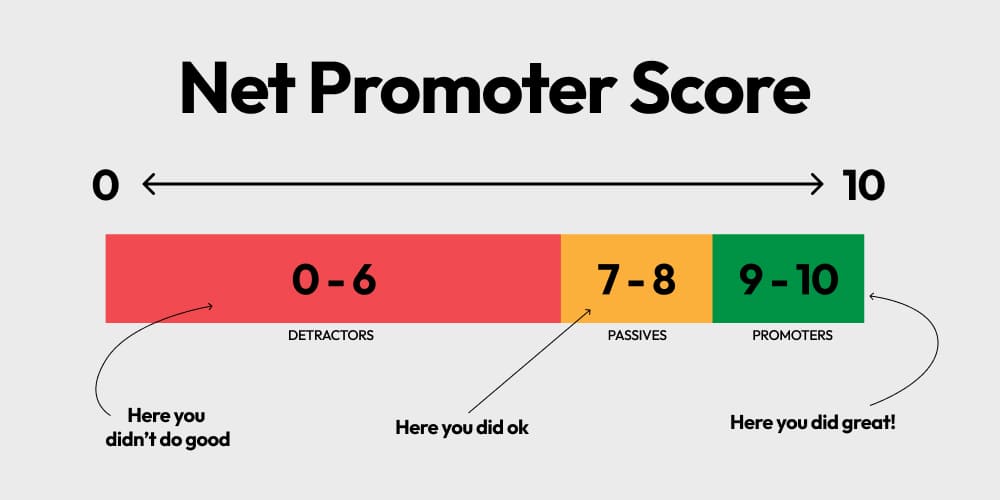
TL;DR Net Promoter Score or shortly NPS, is one of the most widely used metrics for measuring customer loyalty and satisfaction. It’s simple, fast, and deceptively powerful. But only if you understand what it actually tells you and what it doesn’t.
Let’s break it down.
An NPS score measures how likely your customers are to recommend your product or company to someone else.
It’s based on a single question:
“On a scale from 0 to 10, how likely are you to recommend [company/product] to a friend or colleague?”
Based on the answer, customers are grouped into three categories.
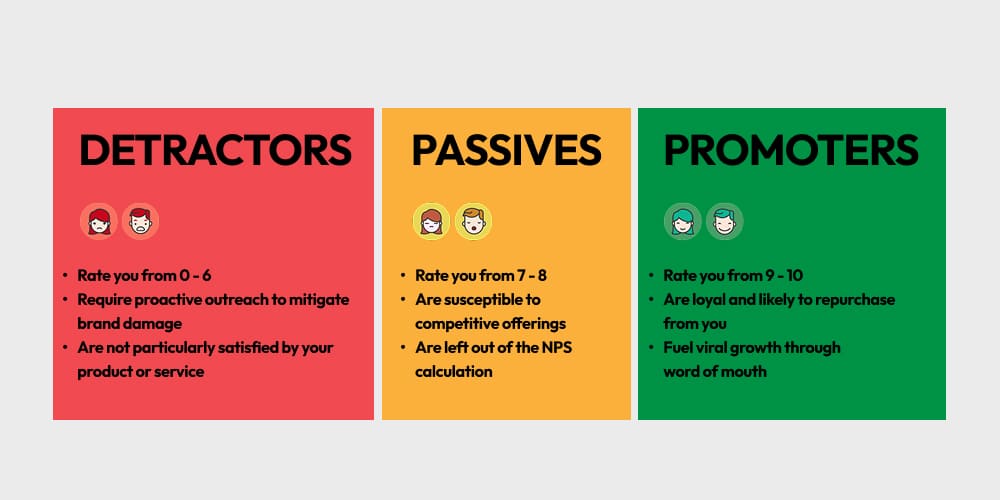
Promoters (9–10)
Loyal enthusiasts. They love your product, stick around, and actively recommend you to others. These people drive organic growth.
Passives (7–8)
Generally satisfied, but not excited. They’re not loyal, and they can easily switch to a competitor if something better comes along.
Detractors (0–6)
Unhappy customers. They’re at risk of churning and may actively harm your brand through negative word-of-mouth.
The calculation is straightforward:
Percentage of Promoters
(Number of Promoters ÷ Total Respondents)×100
Percentage of Detractors
(Number of Detractors ÷ Total Respondents)×100
NPS Score
NPS = Percentage of Promoters - Percentage of Detractors
Your final score ranges from -100 to +100.
Because if you’re a freelancer or a small business owner, this matters way earlier than most people think.
When you’re starting out, asking that one simple question can be critical to:
how people perceive you
whether they recommend you to others
whether they come back to you for another service
You don’t need to remember the exact NPS formula.
You don’t need dashboards or fancy tools.
What you do need to remember is this:
Ask your customers how likely they are to recommend you and why.
That feedback will tell you more about your positioning, service quality, and trust level than most analytics tools ever will.
Below 0 → You have serious issues to address
0 to 30 → Acceptable, but fragile
30 to 70 → Strong customer loyalty
70+ → Exceptional (and rare)
A higher NPS generally indicates stronger loyalty, better retention, and higher growth potential.
But here’s the important part:
The score alone doesn’t fix anything.
NPS is valuable because it:
Measures customer loyalty, not just satisfaction
Helps identify at-risk customers (Detractors)
Highlights brand advocates (Promoters)
Creates a simple, comparable metric over time
Opens the door for qualitative feedback (via follow-up questions)
The real power of NPS comes from the “why” behind the score.
Improving NPS isn’t about gaming the number. It’s about fixing the experience.
If someone gives you a 0–6, reach out within 24–48 hours.
A fast, thoughtful response can turn a bad experience into a loyal customer.
Don’t treat feedback as isolated complaints.
Look for patterns. Ask:
Where in the journey do scores drop?
Is this a product issue, process issue, or expectation issue?
Fix systems, not symptoms.
Support teams should have the authority to solve problems immediately.
Long approval chains kill customer trust.
NPS is not a “support metric.”
Product, design, marketing, sales, everyone influences customer experience.
A good customer service can be a big differentiator here.
If only one team owns NPS, it won’t move.
Promoters are your growth engine.
Ask them for:
Testimonials
Reviews
Referrals
Participation in beta programs or advisory boards
They already like you, let them help you.
Timing matters. Send NPS surveys:
After a purchase
After a workshop
After onboarding
After a support issue is resolved
Random timing = noisy data.
Short. Clear. Mobile-friendly.
One core question + one open follow-up is usually enough.
This group is often the easiest to convert into Promoters with small, thoughtful improvements.
Example:
Someone just finished your workshop. You send a small thank-you gift, a follow-up note, or offer 10% off the next workshop.
That extra care can be the difference between “it was fine” and “wow, I’m recommending you.”
Passives don’t need miracles.
They need to feel seen.
Nothing destroys trust faster than asking for feedback and then doing nothing with it.
Don’t ghost.
There’s nothing worse for a business, or any human relationship, than silence after someone took the time to respond.
If you ask, respond. Even a short acknowledgment goes a long way.
Too many surveys lead to fatigue and worse data.
Again: one simple question, at the right moment, is all you need.
More questions don’t mean better insights. They usually just mean fewer answers.
If you want NPS to actually help your business:
Set up a process to contact unhappy customers directly
Share NPS insights across teams, not just dashboards (if you are a bigger team)
Reward teams for positive customer feedback
Continuously iterate products and services based on real customer input
NPS is not a magic number.
It’s a conversation starter.
Used well, it helps you understand loyalty, spot risks early, and build better experiences. Used poorly, it’s just another metric in a slide deck.
The difference isn’t the score,
it’s what you do after you see it.
When was the last time you checked your NPS to understand how customers actually feel?
If your product isn’t fully aligned with customer expectations, I can help you figure out where the gap is.Book a free discovery call.
Everything you read here is written by me.
I use AI daily. I won’t hype it, because plenty of people already do.
For me, it’s just a tool, something I use in my day-to-day work, and here mainly for formatting or language polish, since English isn’t my first language.
The thinking, experience, opinions, and voice are always mine.