I’m turning this into a short series to help you design your website properly, without overthinking every pixel and sentence.
Today, we’re talking about the About page.
The page everyone knows they need…
and the page almost everyone gets stuck on.
Writing about yourself is uncomfortable. You either say too little, say too much, or accidentally turn it into a LinkedIn summary no one wants to read.
Good news:
Your About page doesn’t need to be complicated and it’s not really about you anyway.
If you missed the first part of this series, start with The Structure of the Perfect Website Home Page Design, then come back here.
What Is the Purpose of Your Website’s About Page?
Yes, your About page tells people who you are.
But more importantly, it answers this question:
“Can I trust this person?”
Your About page is where connection happens.
It’s where people decide:
If they relate to you
If they like how you think
If they feel understood
If working with you feels right
You create that connection by:
Sharing a story they recognize themselves in
Writing like a human, not a brand brochure
Letting some personality show
Being clear about how and why you work the way you do
A good About page doesn’t impress everyone.
It resonates deeply with the right people.
What Does a High-Quality About Page Design Include?
This is where most people get it wrong.
They think the About page should be a full autobiography and then freeze because writing about yourself feels awkward.
Here’s the reframe:
Your About page isn’t about you.
→ It’s about connecting your story to your audience’s problem.
Your experiences only matter if they help someone feel less alone, more understood, or more confident choosing you.
These are the elements that make that happen.
A Headline That Actually Means Something
Please — don’t call your About page headline:
“About Me”
“About [Your Name]”
That tells people nothing.
Your headline should speak directly to how your audience wants to feel after working with you.
Instead of naming the page, position it.
For example:
Confidence in showing up online
Clarity in your brand and website
Feeling proud to send people to your site
Your headline should quietly say:
“You’re in the right place.”
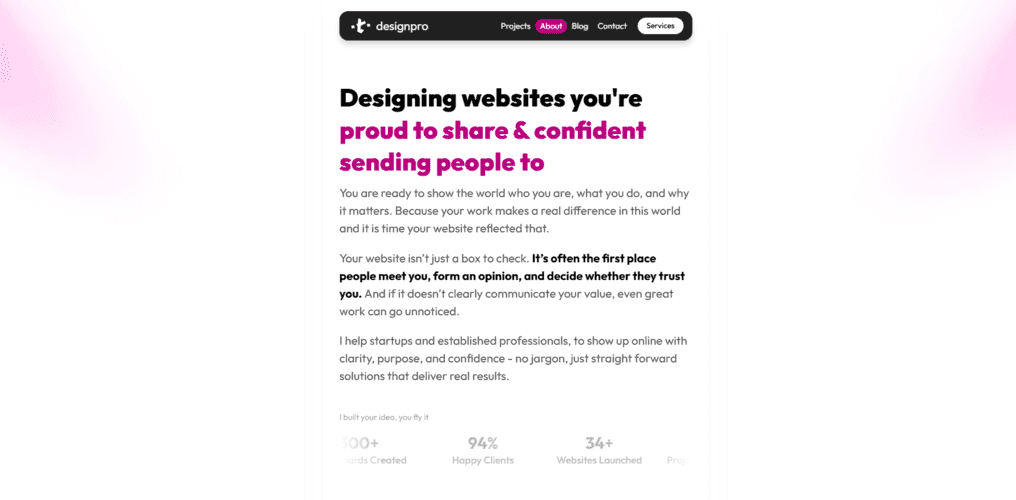
See my example below.
A Story They Can See Themselves In
This is where you build trust.
Start with where you are now, then work backward, but only in ways that are relevant to your services today.
Good prompts to guide your story:
What felt confusing or overwhelming when you were starting out?
What didn’t work, even though it should have?
What finally changed the way you approach design, UX, or branding?
How does that experience help your clients now?
You don’t need drama.
You need recognition.
When someone reads your story and thinks “Oh wow, that’s exactly how I feel”, trust starts forming.
Your Values, Mission, or Way of Working
Your About page is also a great place to explain how you work, not just what you do.
This might include:
What you care about in your work
How you approach collaboration
What kind of clients you work best with
What you won’t compromise on
This naturally attracts people who align with you and repels those who don’t.
That’s not a downside.
That’s filtering.
Make It Fun (Seriously)
Your About page should not read like a CV.
Design and copy should feel human, relaxed, and intentional.
Ways to add personality:
A short “get to know me” section
A few fun or unexpected facts
Humor (if that’s part of your voice)
Unique layout choices or visuals
This is one of the few pages where personality is not optional, it’s the point.
Let people see who they’ll be working with.
Use Plenty of Brand Photography
People don’t hire services.
They hire people.
Your About page should include multiple brand photos:
You working
You in your element
You looking approachable and confident
Brand photos build trust faster than words ever will.
If someone is going to spend money and time working with you, they want to see who’s on the other side.
End With a Clear Call-to-Action
After someone finishes your About page, don’t leave them hanging.
Tell them what to do next.
Usually, that’s:
Exploring your services
Booking a discovery call
Getting in touch
Your About page should gently guide them forward in the journey.
Other Important Things to Consider
Mobile Optimization Still Matters
Most people will read your About page on their phone.
Make sure:
Text is readable
Sections are well spaced
Images don’t overpower the content
CTAs are easy to tap
Your About page should feel just as good on mobile as it does on desktop.
SEO for About Pages (Yes, It Matters)
About pages can be tricky for SEO, but they still matter.
No one is searching for:
“About [Your Name]”
Instead, align your About page with what you actually do.
Good About page SEO titles look like:
About a Web Designer & UX Specialist for Startups
Meet the Designer Behind [Studio Name]
About [Brand Name], a Web Design & Branding Studio
You’re still telling your story, just in a way search engines can understand.
Create Your Perfect Website About Page
Your About page doesn’t need to be perfect.
It needs to be honest, clear, and human.
You’re not trying to impress strangers.
You’re building trust with people who already feel the problem you solve.
If you need help shaping your About page, from structure to copy to design, my Web Design & Development, UX Audit, and Social & Branding services are built to support exactly that.
A quick discovery call is all it takes to get started.
FAQs: About Page Design
What should I include on my About page?
At a minimum:
Who you are
What you do
Who you help
Your story or perspective
Your values or approach
A clear call-to-action
What are common About page mistakes?
The biggest one: treating it like a resume.
Your About page is not LinkedIn.
It’s not a list of titles or tools.
It’s a chance to build trust and connection, and copied, generic bios do the opposite.
How do I write a catchy bio?
By sounding like yourself.
Compare these two:
Version 1:
Hi, I’m X. I’m a web designer, UX specialist, and branding consultant. I help businesses improve their online presence.
Version 2:
Hi, I’m X. I help founders turn confusing websites into clear, conversion-focused experiences they’re actually proud to share.
Same information.
Very different feeling.
Your bio should tell people what you do and how it helps them.